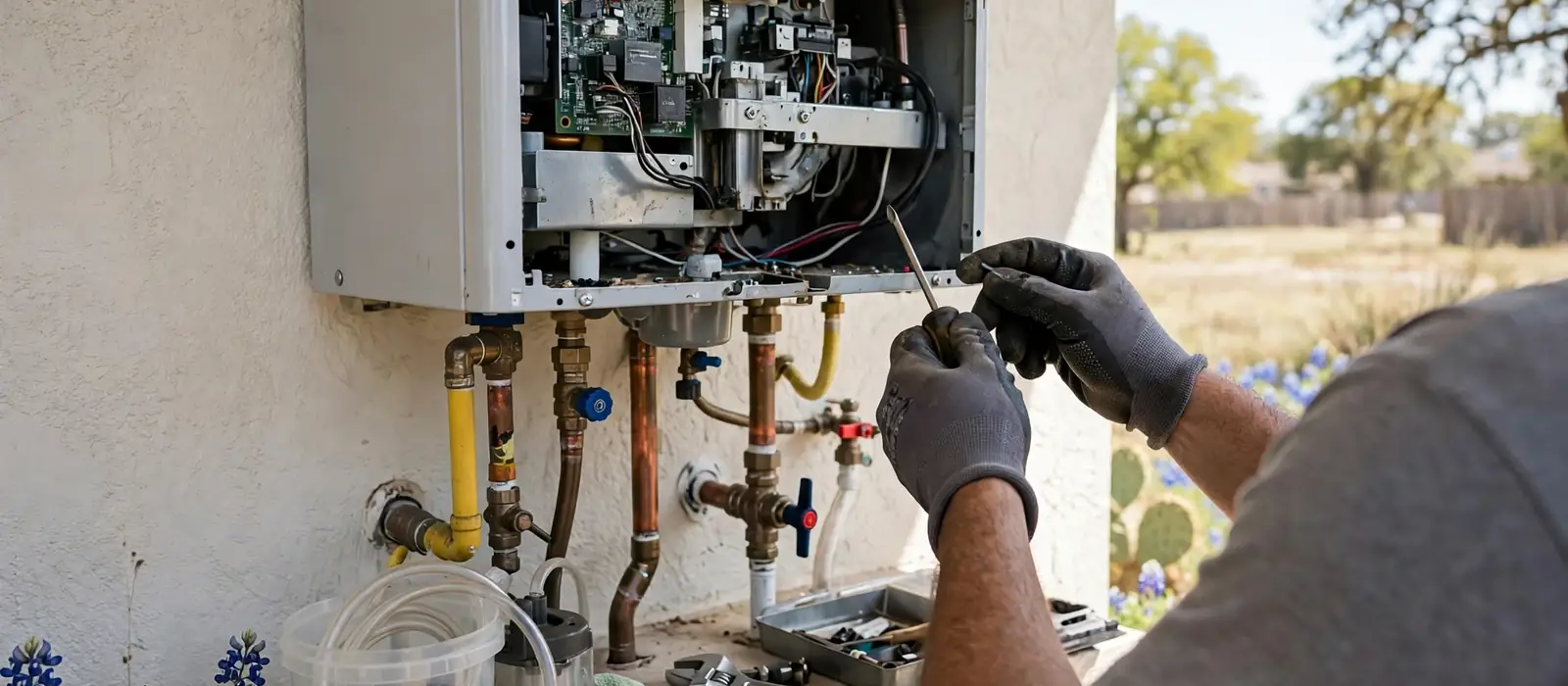
How tankless water heaters work in Farmington homes
A tankless heater fires a burner or energizes elements when it senses flow, and it stops when the tap closes. There is no stored water to run out, so the limit is flow rate rather than tank size. A gas unit sized for the household can supply two showers at once without a pause.
Installing one is a bigger job than a tank swap. Gas units usually need a larger gas line, stainless venting and a condensate drain. Electric units need heavy circuits that many panels cannot support. Our installation page describes the planning that comes first.
Why flushing and descaling matter here
Farmington City reports hardness of 8 grains per gallon south of 600 North and 10 grains per gallon north of it. Heat drives that hardness out of the water and onto the heat exchanger, where scale narrows passages and triggers error codes.
Many tankless owners see error codes, rising gas bills or lukewarm output after a few years. A flush with a vinegar or descaling solution, run through isolation valves, restores flow. Without isolation valves, the plumber installs them first, which is why we recommend them on every new tankless install.
A whole-house water softener reduces how fast scale builds. If you have a softener already, check that it is regenerating properly, since a depleted one lets hardness through.
Signs a tankless heater needs service
Tankless heaters usually send early warnings. These are the ones to act on.
- Error codes on the display, especially those tied to flow, ignition or exhaust.
- Water that fluctuates from hot to cold during a shower.
- A rumbling or hissing noise from the unit.
- A drop in output compared with when the unit was installed.
- A gas smell, which means leave the house and call 911 or your gas utility first.
If the plumber finds the heat exchanger damaged, repair or replacement may follow. Our water heater repair page covers diagnosis for all types.
Tank and tankless side by side
Neither type is right for every home. This table shows the trade-offs plumbers explain on a visit.
| Factor | Tank heater | Tankless heater |
|---|---|---|
| Hot water supply | Limited by tank size | Continuous, limited by flow rate. |
| Upfront price | Lower | Higher, with venting and gas work. |
| Maintenance | Annual flush and anode rod check | Annual flush and descale through isolation valves. |
| Space | A floor footprint | A wall mount that frees floor space. |
| Life expectancy | Often 8 to 12 years | Often longer when serviced regularly. |
The numbers are general ranges. A plumber can give a firmer estimate after seeing your unit.
Installing or converting to tankless
Converting from a tank to a tankless unit starts with the gas line size and the vent path. A 40 gallon tank may run on a half-inch line, but a tankless unit can need three-quarter inch pipe to feed the full burner load. If the vent runs through an attic or exterior wall, the clearances matter.
The plumber also plans a condensate drain for high-efficiency models and a pressure relief valve with a discharge pipe. Permit rules apply: Farmington's building department lists plumbing systems among the work that needs a permit, so ask the department about your project.
Tankless heater showing an error?
Call (385) 488-1892 to talk it through.
What affects tankless costs
Tankless prices vary by situation, so these factors explain the range.
Common questions
Many manufacturers recommend yearly service, and hard water such as Farmington's can shorten that interval. Check your unit's manual and ask the plumber about your usage.
Yes. Codes for flow, ignition, exhaust and temperature are common.
They are more sensitive to scale than tanks, so a softener or scale inhibitor protects the heat exchanger. Ask the plumber about your water and usage.
Often not without upgrading. Tankless units draw more gas at once than tanks, so the plumber checks the meter capacity, the pipe size and the run length.
Farmington's building department lists plumbing systems among the work that needs a permit. Rules vary by project, so ask the department.
Sources and where to verify
Written by the Farmington 24/7 Plumbing team using the public sources below, which you can check yourself.
- Farmington City water department and its published water quality report: Water source, hardness and service line responsibility.
- Farmington building department: Permit and excavation rules.
- Utah Division of Professional Licensing plumbing FAQ: Plumber licensing in Utah.
Plumbing work in Utah follows the International Plumbing Code (IPC) with Utah amendments, and plumbers working in Utah are expected to work to it.