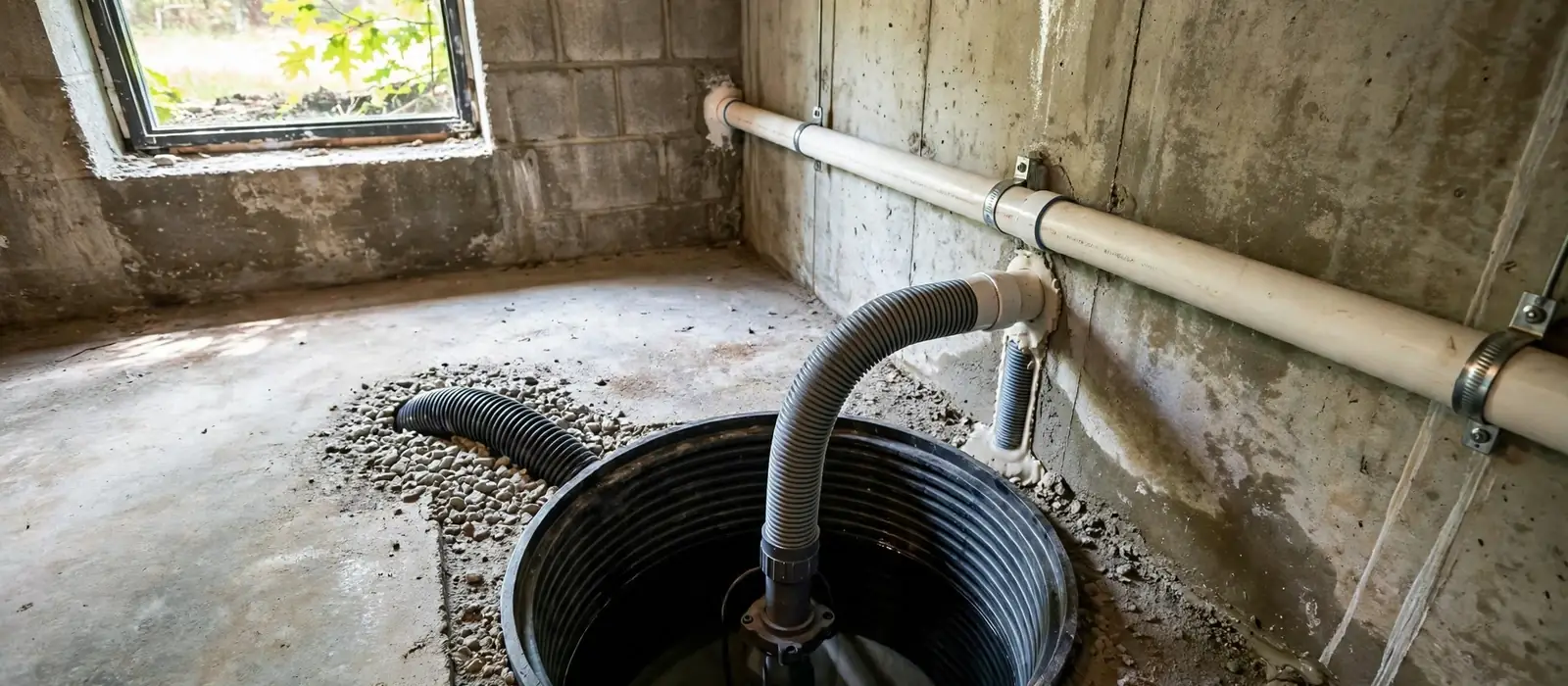
Sump pump emergency: what to do first
A few quick checks fix some failures, and they help the plumber arrive with the right parts.
- Check that the pump is plugged in and the breaker has not tripped.
- Lift the float by hand. If the pump runs, the float is stuck or tangled.
- Look for a clogged discharge pipe outside, since ice or debris can block it.
- Move belongings off the floor and away from walls.
- Avoid standing in water near outlets or appliances. Call the line at (385) 488-1892.
If the basement is already flooding, the plumber can also advise on water removal and drying. Drainage fixes appear on our basement waterproofing page.
Why sump pumps fail
Most failures are predictable. These six causes cover most calls.
Stuck float
The float switch jams against the basin wall and never starts the pump.
Clogged intake
Silt and gravel clog the pump inlet and the motor overheats.
Power loss
A storm that takes out power also takes out the pump.
Age
Motors wear out, and a pump that has run for ten years or more is at risk.
Frozen or blocked discharge
Water cannot leave the pipe, so the pump runs without moving it.
Undersized pump
The pump cannot keep up with the water that arrives.
Water in a Farmington basement
Finished basements are common in the neighborhoods that grew around Station Park and the foothills near Lagoon, and a basement is only as dry as the water it can shed. A sump pit collects groundwater from the drain tile around the footing and pumps it out before it rises through the floor.
Seasonal water is the usual trigger on the Wasatch Front. Snowmelt in spring and heavy summer storms can raise the water around a foundation, and a pump that has sat idle all winter may fail at the first big test. Test yours by pouring a bucket of water into the pit and watching the float lift and the pump run.
Discharge matters as much as the pump. The outlet pipe should carry water well away from the foundation, and the pump should not discharge into a sanitary sewer line. Farmington's building department lists plumbing systems among the work that needs a permit, so ask about requirements before a new installation.
Pump types compared
A good setup often pairs a main pump with a battery backup. The plumber sizes the system to the pit and the inflow.
| Type | How it works | Best fit |
|---|---|---|
| Submersible | Sits in the pit, quiet and compact | Most homes. |
| Pedestal | Motor sits above the pit, easier to service | Tight budgets and shallow pits. |
| Battery backup | A second pump runs on a battery during power loss | Any home where outages and storms overlap. |
| Water-powered backup | Uses city water pressure to run a backup | Where a battery is not practical. |
Water-powered backups use extra city water and may be restricted in some places, so ask before choosing one.
Testing your pump before the wet season
A two-minute test in spring and fall catches most failures before they matter.
- Unplug the pump, clean the pit and plug it back in.
- Pour a bucket of water into the pit and watch the float rise.
- Confirm the pump starts, empties the pit and shuts off.
- Check the discharge outlet outside for ice, leaves or kinks.
- Make sure the pump is on a GFCI outlet, tested monthly.
Sump pump failed?
Call (385) 488-1892 to talk it through.
What affects sump pump cost
Sump work varies, and the plumber states the price before starting.
Common questions
Check that it is plugged in and that the breaker has not tripped, then lift the float to see whether the pump runs. If the pit keeps filling, move belongings off the floor and call (385) 488-1892.
Test it at least twice a year, and before spring thaw and the stormy season. Pour water into the pit and watch the pump start and clear it.
If a power outage during a storm would flood your basement, yes. A backup runs the pump when the grid is down.
Many last around 7 to 10 years, and heavy use shortens that.
No. A pump removes water that reaches the pit. Waterproofing keeps water out of the basement. See basement waterproofing.
Yes. See our Kaysville and Centerville pages.
Sources and where to verify
Written by the Farmington 24/7 Plumbing team using the public sources below, which you can check yourself.
- Farmington City water department and its published water quality report: Water source, hardness and service line responsibility.
- Farmington building department: Permit and excavation rules.
- Utah Division of Professional Licensing plumbing FAQ: Plumber licensing in Utah.
Plumbing work in Utah follows the International Plumbing Code (IPC) with Utah amendments, and plumbers working in Utah are expected to work to it.