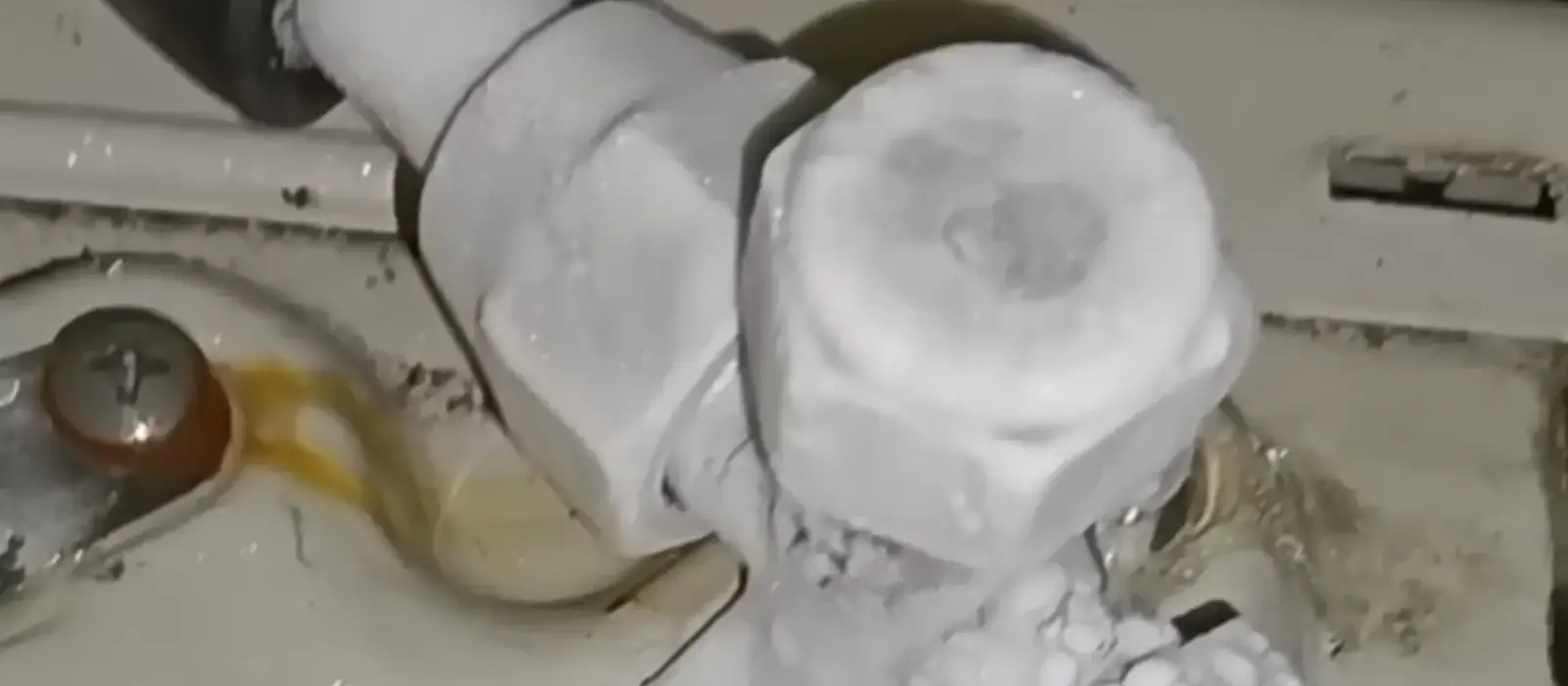
First steps for a frozen tankless heater
The goal is slow, even warming. Fast heat can crack a frozen pipe or fitting.
- Turn the unit off at the switch and shut off the gas or electric supply.
- Close the cold water supply valve to the heater.
- Open a hot water faucet nearby so melting ice has a path.
- Warm the room slowly with a space heater at a safe distance or by opening a door to a heated space.
- Do not use a flame, a torch or a hair dryer on a gas line.
If the unit is outdoors, move to the next section, and call a plumber if pipes are visibly split.
Why tankless heaters freeze
A tankless unit holds very little water, but the water it holds sits in a small heat exchanger and thin pipes. Built-in freeze protection works only if the unit has power. A power outage or an unplugged unit during a cold night leaves the internal heater off and the pipes exposed.
Location matters too. A heater on an exterior wall, in an unheated garage or in a vented crawlspace sees cold air constantly. Drafts through a vent pipe or a gap in the wall add to the risk. Condensate lines on high-efficiency units also freeze, which can trigger an error code even when the heater itself is fine.
Symptoms and what they usually mean
The sign shows what to check first. Ice damage is common after a hard freeze.
| What you notice | Likely cause | What to do |
|---|---|---|
| No hot water, display on | Frozen supply line or heat exchanger | Shut off, thaw slowly, check for leaks. |
| Error code about flow or ignition | Ice in a line or a frozen condensate drain | Thaw, then clear the condensate line. |
| Dripping from the unit | A cracked fitting or exchanger | Shut off water, call a plumber. |
| Unit completely dead | Power lost or unit damaged | Check the breaker and call if it stays dead. |
If the unit uses gas, never relight a damaged unit yourself.
Cold weather and old pipe in Farmington
Farmington sits on the Wasatch Front, where overnight freezes catch exposed lines in garages, crawlspaces and outside walls. Older homes near the Main Street Historic District, which dates from about 1853, can have uninsulated runs that freeze even when the house is warm. Tankless units on exterior walls sit in the same risk zone.
Farmington's water department says property owners are responsible for private service lines and for leaks inside the home, so a split line behind a tankless heater is the owner's repair. If the freeze breaks a pipe, see burst pipe repair. Hard water, 8 to 10 grains per gallon in Farmington, also scales the heat exchanger, which makes a freeze crack more likely to stay hidden.
Source type: Farmington City water department and city history pages.
How to protect a tankless heater before the next freeze
Prevention costs far less than a cracked heat exchanger.
- Keep the unit plugged in and the breaker on all winter, since freeze protection needs power.
- Insulate exposed supply lines and seal drafts around the vent pipe.
- Keep a trickle of hot water running on the coldest nights if the unit is exposed.
- Drain and winterize any unit that serves a seasonal space such as a cabin or outbuilding.
- Add a battery backup if outages are common in your area.
Flush and inspect after a freeze
A tankless heater that froze once may have cracked a seal that has not leaked yet. After a freeze, run the unit through a flush using the isolation valves, check the filter screen and look for slow drips at every connection over the next few days.
That flush also removes scale. See our tankless water heater page for service details, and water heater repair if the unit shows persistent errors. A plumber can test the exchanger and tell you whether the unit is still sound.
What a cracked heat exchanger looks like
Ice expands as it freezes, and a tankless heat exchanger has thin copper or stainless passages with little room to give. A crack may show as water pooling under the unit, a pressure drop at the faucets or an error code that returns after every restart. Some cracks only leak under pressure, so a unit that seems fine after thawing can start dripping hours later.
If you see water, shut off the supply and the gas or power right away and call a plumber. A small leak damages the unit's circuit board and whatever is below it.
Thaw safely or call a plumber
Use this table as a quick guide when the temperature has dropped and the heater has stopped.
| Situation | Safe to try | Call a plumber |
|---|---|---|
| Frozen supply pipe, no leak | Slow warming and waiting | If pipes will not thaw. |
| Error code after freeze | Restart after the unit thaws | If the code returns. |
| Water on the floor | Shut off water and power | Yes, right away. |
| Gas smell | Leave the house | Call 911 or the gas utility first. |
After the unit thaws, run hot water for a few minutes and check the connections again.
Preparing before the first hard freeze
Walk through the house in early fall. Find the tankless unit, check the power, look at the pipe insulation and seal any draft around the vent. If your heater serves a garage or outbuilding, ask a plumber about draining it for the season. Our water heater repair team can inspect a tankless unit in minutes, and the visit costs less than a repair.
Write down the unit's model and the location of its shutoff valves. If a freeze hits at night, you can shut it down without hunting for the manual.
Insurance, photos and what to keep
If a freeze damages the unit or floods a garage, photograph the unit, the pipes and any water damage before cleanup. Keep the receipt for any emergency repair and the plumber's note on the cause of failure. Many insurers want those details, and a clear record speeds a claim.
Ask your agent how your policy treats freeze damage to appliances. Some cover the resulting water damage but not the heater, and some exclude damage when the home was left unheated. Knowing before winter is better than finding out in February.
Frozen heater or no hot water?
Call (385) 488-1892 to talk it through.
Questions from Farmington homeowners
Slow warming is safe. Never use a flame or torch, and never relight a gas unit that shows damage.
Look for water on or under the unit after the thaw, and for pressure loss or dripping. If you see any, shut off the water and call.
Some policies cover sudden freeze damage but not the unit itself. Photograph everything and ask your agent.
Farmington's hardness of 8 to 10 grains per gallon makes yearly flushing a sensible start. Check your unit's manual.
Outdoor units need freeze protection and power all winter. Call a plumber to check it before the next cold snap.
Sources and where to verify
Written by the Farmington 24/7 Plumbing team using the public sources below, which you can check yourself.
- Farmington City water department and its published water quality report: Water source, hardness and service line responsibility.
- Farmington building department: Permit and excavation rules.
- Utah Division of Professional Licensing plumbing FAQ: Plumber licensing in Utah.
Plumbing work in Utah follows the International Plumbing Code (IPC) with Utah amendments, and plumbers working in Utah are expected to work to it.