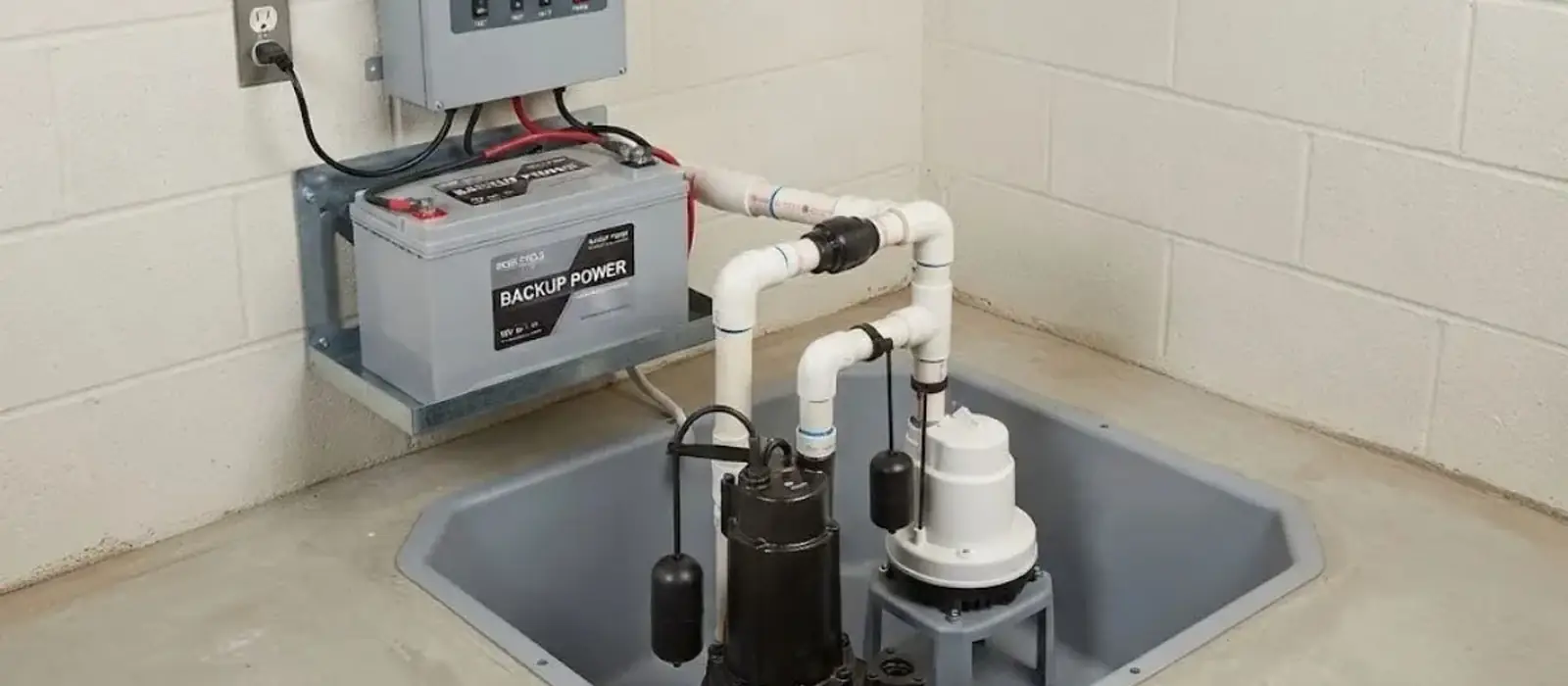
Why the backup matters
A standard sump pump needs household power. The storms and fast snowmelt that raise groundwater are the same events that knock out power on the Wasatch Front. A pump that cannot run during an outage leaves the basement with no protection at the worst moment.
A backup also covers mechanical failure. The main pump can jam, clog or burn out, and a second pump with its own float switch starts when the water rises past the first one. That redundancy is the point.
Backup types
Each backup has strengths. Plumbers usually recommend the battery type because it runs automatically.
Battery-powered pump
A second submersible pump runs off a deep cycle battery with a charger. The most common option.
All-in-one system
A combined primary and backup unit, which can simplify a small pit.
Water-powered backup
Uses city water pressure to move water out. It uses extra water and may not be allowed everywhere.
Generator
A whole-house or portable generator can power the main pump, but it must be started and kept fueled.
What installation involves
A backup system installs in a few hours when the pit is the right size. These are the steps.
Check the pit
The plumber confirms pit size, depth and whether it fits a second pump.
Set the backup pump
A backup pump is placed in the pit, with its float set slightly higher than the main pump's.
Connect discharge
A check valve and a connection to the discharge line keep water from flowing back.
Mount the battery and charger
The battery goes on a shelf or a platform off the floor, with a charger and a vented box.
Test both pumps
Water is added to the pit to verify each pump starts and clears it.
How long a battery lasts
Runtime depends on how hard the pump works, so a heavy storm drains a battery faster than a light one.
| Factor | Effect on runtime |
|---|---|
| Battery capacity | Larger batteries run longer between charges. |
| Pump size | A larger pump drains faster but uses more power. |
| Inflow rate | More water means more runs per hour. |
| Battery age | Batteries lose capacity and need replacement every few years. |
| Charger and monitoring | A working charger keeps the battery ready. |
A plumber can estimate the runtime for your pit and pump and advise whether a second battery is needed.
Basements, permits and discharge rules in Farmington
Many Farmington neighborhoods grew in the decades after the city's population began to double in 1980, and finished basements are common in the newer subdivisions near Station Park, which opened in 2011, and near Lagoon. Farmington's building department lists plumbing systems among the work that needs a permit, and a new pump and discharge line may fall under that, so ask the department about your project.
Discharge matters. Pumped water should go well away from the foundation and not into the sanitary sewer line. Ask the plumber where your discharge goes and whether it needs to be extended. See sump pump repair and installation for more.
Source type: Farmington City building department pages.
Maintaining a backup system
A backup that is not tested may not work when needed. These steps take about fifteen minutes.
- Test both pumps every few months by pouring water into the pit.
- Check that the battery charger shows a charged battery.
- Clear the pit of silt and debris once a year.
- Replace the battery on the schedule in the manual.
- Check the discharge outlet outside for ice and blockage.
What happens during a long outage
A battery backup runs only as long as its battery holds. In a heavy storm with constant inflow, the pump may run continuously and drain the battery in hours. That is why a battery's size, age and charge matter as much as the pump.
If outages in your area are long, consider a second battery or a charger with a monitor that alerts you when the battery is low. Many systems include an alarm that sounds when the pump runs on battery or when the water rises to a high level.
Choosing the right backup for your pit
The pit decides what fits. A plumber measures it before recommending a system.
| Pit condition | Best fit |
|---|---|
| Small pit, tight space | A compact all-in-one system. |
| Large pit with room | A second submersible backup pump. |
| Frequent long outages | A larger battery or a generator. |
| No electrical outlet nearby | A plumber or electrician to add one. |
| Finished basement | Full backup with an alarm. |
Ask for a recommendation in writing so you can compare options.
Why a backup is not a substitute for a good main pump
A backup is a safety net, not the primary worker. The main pump should be sized to the inflow, the pit should be clean and the discharge should be clear. If the main pump runs constantly or cycles rapidly, the problem is upstream, in drainage or pump size, and a backup will not solve it.
See basement waterproofing for drainage fixes that reduce the load on the pump.
Alarms, monitoring and peace of mind
Many backup systems include an alarm that sounds when the main pump fails, the battery runs low or the water level rises. Some connect to a phone and send an alert. An alarm matters most when you are away from home, because a quiet failure can flood a basement before anyone notices.
Ask the plumber about adding one. A basic audible alarm costs little, and a connected alarm can give you a text when something changes. For more on pumps, see sump pump repair and installation, and our Layton page for coverage up north.
Safety steps when you work near a sump pit
Electricity, water and batteries share this space, so the safest approach is to cut power first.
- Unplug the pump and disconnect the battery before reaching into the pit.
- Never touch a pump, cord or charger while standing in water.
- Vent the battery box, since batteries can give off gas while charging.
- Keep children and pets away from an open pit.
- Do not run a generator in the basement or garage. Exhaust contains carbon monoxide.
Signs your main pump is wearing out
A pump that cycles on and off every few seconds, runs with a grinding noise or does not shut off is nearing the end. A float switch that sticks, an oily smell or a pit that fills slowly are also warnings. Replacing a tired main pump before the wet season avoids a failure when the backup is the only defense.
Add a note to your calendar to test the system twice a year. If it is more than seven years old, ask a plumber to look at it. See our Kaysville page for coverage north of Farmington.
Want a backup installed?
Call (385) 488-1892 to talk it through.
Questions from Farmington homeowners
A generator helps if you are home and it is running. A battery backup starts automatically, even if you are away.
It depends on the battery, the pump and how much water arrives. A plumber can estimate it for your pit.
Many can, if the pit is large enough for a second pump. A plumber checks the pit before installation.
The system is not usually covered, but a water backup endorsement may cover damage from pump failure. Ask your agent.
Yes. See our Centerville and Kaysville pages.
Check power and the float first, then call (385) 488-1892 and say how fast the pit is filling. Move belongings off the floor while you wait.
Sources and where to verify
Written by the Farmington 24/7 Plumbing team using the public sources below, which you can check yourself.
- Farmington City water department and its published water quality report: Water source, hardness and service line responsibility.
- Farmington building department: Permit and excavation rules.
- Utah Division of Professional Licensing plumbing FAQ: Plumber licensing in Utah.
Plumbing work in Utah follows the International Plumbing Code (IPC) with Utah amendments, and plumbers working in Utah are expected to work to it.