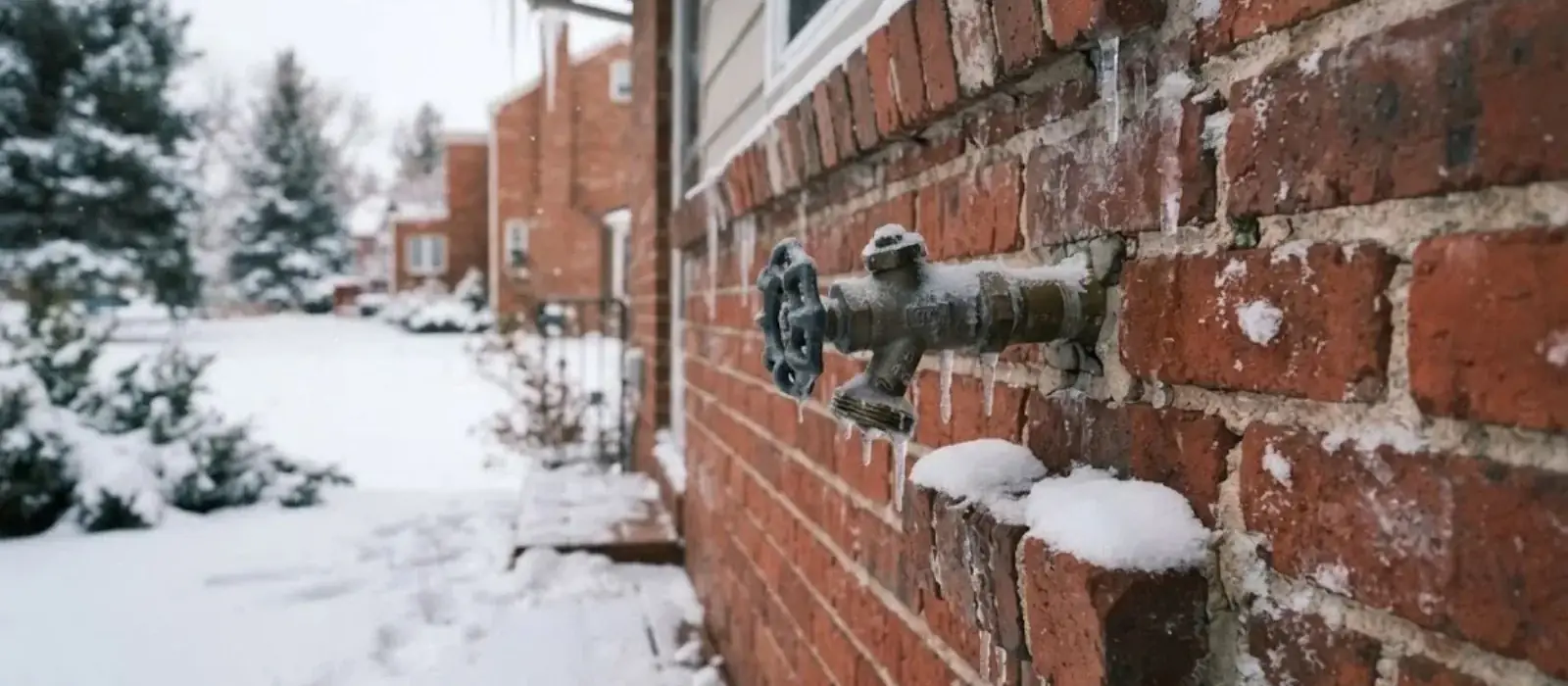
What an anti-siphon faucet does
A hose left submerged in a bucket, a pool or a fertilizer sprayer can pull water backward if household pressure drops. A vacuum breaker, also called an anti-siphon valve, opens to air and stops that flow. It is a backflow device, and it protects your household water from contamination.
The device is small and exposed, so it wears. A small spurt from the cap when the faucet is on is normal. A steady spray or drip is not, and it means the washer or the whole breaker needs replacing.
Common faucet problems
Where the water shows tells you where the part has failed.
Spray from the vacuum breaker
The internal washer or poppet is worn.
Drip from the spout when off
The stem washer or the faucet seat is worn.
Leak at the handle
The packing nut or O-ring has failed.
Water inside the wall
A frozen and split pipe behind the faucet.
No flow
A closed shutoff, a clogged screen or a frozen line.
If water appears inside after a freeze, see burst pipe repair.
Repairing the vacuum breaker
A breaker swap takes about ten minutes and costs little. The parts are standard.
Shut off the water
Close the interior shutoff to the faucet or the main valve.
Open the faucet
Drain any water left in the line.
Unscrew the breaker
Turn the cap counterclockwise. Some require a set screw.
Replace the part
Swap the washer or the whole vacuum breaker, matching the thread size.
Test
Turn the water on slowly, open the faucet and check for leaks.
Freeze risk and backflow rules in Farmington
Farmington's winters freeze outdoor lines, and a hose left connected can trap water in the faucet and split the pipe inside the wall, which shows up in spring as damp drywall. Disconnect hoses before the first hard freeze, and shut off and drain the faucet if an interior shutoff exists. Frost-free faucets help, but only if the hose is removed.
Backflow devices matter for sprinkler systems as well. A nearby city page, Kaysville's, says drinking water is not allowed in outdoor sprinkler systems except in limited cases with documented permission, and backflow test reports go to the city. Farmington's building department lists plumbing systems among the work that needs a permit, so confirm any irrigation work with the city. Per Farmington's water department, owners are responsible for private lines and leaks inside the home.
Source type: Farmington City water and building department pages and a neighboring city's code.
Repair or replace the faucet
Cheap repairs work for simple wear. Corrosion or hidden leaks call for replacement.
| Situation | Usually |
|---|---|
| Spray from the breaker only | Replace the breaker or washer. |
| Drip at the spout | Replace the stem washer or seat. |
| Corroded or seized stem | Replace the faucet. |
| Water inside the wall | Plumber repair after a freeze. |
| Old faucet with no shutoff | Replace and add an interior shutoff. |
Our faucet repair page covers indoor and outdoor faucets.
What happens when backflow protection fails
A hose attached to a fertilizer sprayer, a pool or a bucket creates a path for contaminated water to be drawn into your plumbing if the supply pressure falls. A drop can come from a main break, a firefighter opening a hydrant or a heavy draw nearby. The anti-siphon valve is the small device that keeps that water out of your home.
That makes a broken or missing vacuum breaker more than a nuisance. It is a health protection, and replacing one is a small price for peace of mind.
Winter shutdown checklist for outdoor faucets
Five minutes in the fall can prevent a split pipe and a wet wall in spring.
- Disconnect every hose, splitter and timer before the first hard freeze.
- Shut off the interior valve that feeds the faucet, if you have one.
- Open the outside faucet to drain the line.
- Cover the faucet with an insulated cap if it is exposed.
- Check for a drip in spring and fix it before it freezes again.
Frost-free faucets
A frost-free faucet puts the shutoff valve inside the heated wall, so the outside spout can drain after you close it. It works only if the hose is removed and the faucet slopes slightly downward. If the faucet is installed level or upward, water sits in the barrel and can still freeze.
If you are replacing an old faucet, ask the plumber about a frost-free model with a built-in vacuum breaker. Our faucet repair team can install it.
Choosing a replacement faucet
When you replace an outdoor faucet, pick a frost-free model with a built-in vacuum breaker, and make sure the length fits the wall thickness. Brass bodies resist corrosion better than cheaper alloys. Check that the thread size matches your hose and that the shutoff valve is on the inside of a heated space.
If the old faucet is soldered into a copper line, replacement may require cutting and soldering or a push fit connector. If you are not comfortable with that, a plumber can do it in under an hour.
Signs and likely causes
Where water shows is the best clue to the cause.
| Sign | Likely cause | Fix |
|---|---|---|
| Spray from the cap | Worn vacuum breaker | Replace the breaker. |
| Drip from the spout | Worn washer or seat | Replace the stem washer. |
| Handle leaks | Failed packing | Tighten or replace the packing. |
| No flow in spring | Frozen or split pipe | Plumber repair. |
If you see water inside after a freeze, call a plumber right away.
What to do before you start the repair
Pressurized water and cold weather call for a few simple precautions.
- Shut off the water to the faucet and open it to relieve pressure before unscrewing anything.
- Do not work on a faucet that is spraying near an outlet, an electric meter or a panel.
- Wear eye protection when opening a pressurized fitting.
- Never use a flame to thaw a frozen faucet or pipe.
- Call a plumber if water appears inside the wall.
Spring startup checklist
When the freeze danger is over, reconnect the interior shutoff, close the outside faucet and open it slowly. Watch the wall and ceiling inside for a few minutes, since a split pipe will show as a drip or a stain. Run water through the faucet and check the vacuum breaker for a steady spray.
If you find a leak, close the shutoff and call. A small crack can become a flood once the line is under full pressure. Our Centerville page shows coverage south of Farmington.
Hoses, timers and splitters
Leave the hose off during the winter and drain it before storing. Timers and splitters hold water and can crack. A hose left on all winter is the usual reason an outdoor faucet splits. If you use a drip irrigation system, ask the plumber about a dedicated backflow device on the line.
Outdoor faucet leaking?
Call (385) 488-1892 to talk it through.
Questions from Farmington homeowners
A short spurt when the water first turns on is normal. A steady spray means the part is worn.
Yes. Match the thread size and type, and replace the whole breaker if the washer is not sold alone.
Shut off the water and call. A frozen split pipe needs a plumber.
Yes. Disconnect hoses before freezing weather, and shut off and drain the faucet if you can.
Many plumbing codes require them on hose bibs. Ask the Farmington building department about your home.
Sources and where to verify
Written by the Farmington 24/7 Plumbing team using the public sources below, which you can check yourself.
- Farmington City water department and its published water quality report: Water source, hardness and service line responsibility.
- Farmington building department: Permit and excavation rules.
- Utah Division of Professional Licensing plumbing FAQ: Plumber licensing in Utah.
Plumbing work in Utah follows the International Plumbing Code (IPC) with Utah amendments, and plumbers working in Utah are expected to work to it.