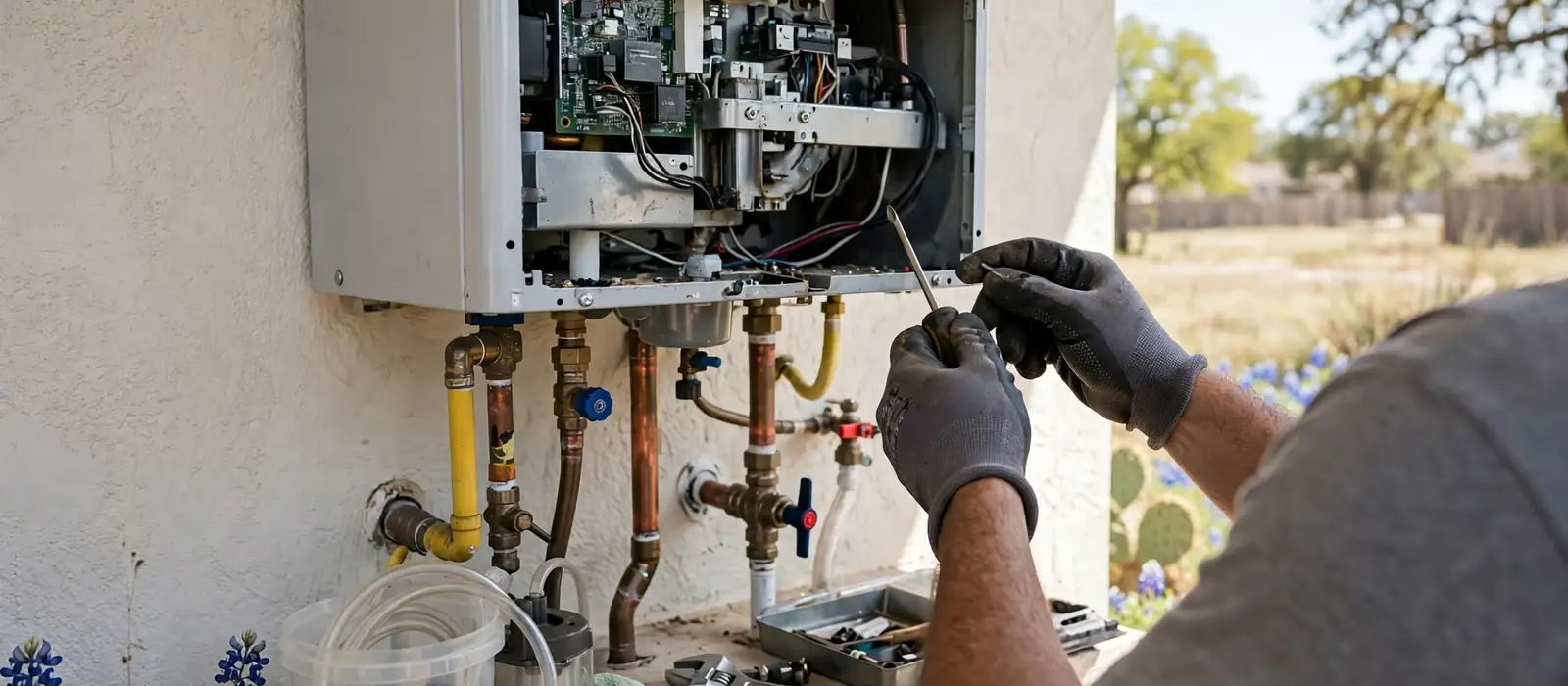
Outdoor and indoor tankless side by side
Neither option wins everywhere. This table shows the trade-offs that matter most on the Wasatch Front.
| Factor | Outdoor unit | Indoor unit |
|---|---|---|
| Space | Frees a utility room or closet | Takes wall space indoors. |
| Venting | Short or no vent pipe | Needs a vent through the wall or roof. |
| Winter risk | Highest, since pipes and unit see outdoor air | Lower. |
| Power dependence | Freeze protection needs steady power | Less critical. |
| Servicing | Weather affects access | Easier in all seasons. |
A plumber can look at your wall, gas line and power to see which fits.
What an outdoor installation requires
Outdoor means weatherproofing in every connection. These six items make or break an installation.
- A unit certified for outdoor use, not an indoor model in a box.
- A dedicated power circuit for the heater and its freeze protection.
- Insulated supply and return lines, with heat tape where the manufacturer allows.
- Clearances from doors, windows, vents and the gas meter as the manual and local code require.
- A gas line sized for the unit's full burner load.
- A condensate drain or neutralizer for condensing models, protected from freezing.
Cold weather is the whole question
Farmington sits on the Wasatch Front, where overnight freezes are normal in winter. A tankless heater holds little water, so it can freeze quickly if power is lost or the freeze protection fails. A cracked heat exchanger from ice is an expensive repair.
Many installers recommend a location sheltered by a covered porch or a protected side of the house, a battery or generator backup for outages and a drain-down routine for long absences. If the home is a seasonal or rarely used property, draining the unit for winter is cheap insurance. Our guide to a frozen unit lives on the tankless water heater page.
Hard water and permits for outdoor units in Farmington
Farmington City reports hardness of 8 grains per gallon south of 600 North and 10 north of it. Scale will build in an outdoor unit as it does in an indoor one. Isolation valves for yearly flushing should be part of the installation, and they need to be reachable and protected from weather.
Farmington's building department lists plumbing systems among the work that needs a permit, and gas work adds its own requirements. Ask the department about your project, and expect an inspection. A plumber can describe what the installation includes.
Source type: Farmington City water department and building department pages.
How the installation proceeds
Planning is most of the job. The visible work goes quickly once the plan is right.
Survey
The plumber checks gas line size, power, wall condition and clearances.
Mount and connect
The unit is mounted, then water, gas and power are connected with weatherproof fittings.
Test
Gas leak test, ignition, flow and freeze protection checks before the plumber leaves.
Is outdoor the right call for your house?
If your utility room is crowded or you are adding a unit to a detached space, outdoor makes sense. If the main reason is cost, compare it with an indoor unit on a garage wall, which has fewer winter risks. Our water heater installation page covers the planning questions.
A plumber can also review whether your gas meter and line can support a tankless unit. Many homes need a larger line, and that cost is the same inside or out.
Power backup and freeze protection in practice
Most outdoor tankless units use small electric heaters inside the casing to keep the water from freezing. Those heaters draw power only when the temperature falls to a set point, which means they rely on grid power during exactly the cold nights when outages happen. A small backup battery or a generator transfer switch lets the freeze protection keep working.
Heat tape on the supply lines is another layer, and it also needs power. Insulate every exposed pipe and the shutoff valves. A plumber can plan the layers so one failure does not freeze the whole system.
Alternatives if outdoor installation is a poor fit
Outdoor is not the only way to save indoor space. Consider these five before you commit.
- An indoor unit on a garage wall with a short vent run.
- An indoor unit in a basement or utility room.
- A tank heater, which holds heat and is less sensitive to a brief outage.
- A hybrid unit in a conditioned space.
- A point-of-use electric unit for a distant bathroom.
A plumber can compare the options and the cost of each on a visit.
Maintenance for an outdoor unit
An outdoor heater sees dust, spiders, snow and rain. Check the air intake and the exhaust in spring and fall, clear debris, inspect the weather seals and flush the heat exchanger once a year. See water heater installation for planning questions.
Keep snow and ice from piling against the unit, and check the condensate line, since a frozen condensate drain is a common cause of a winter shutdown.
Questions to ask an installer about an outdoor unit
Ask which models are rated for outdoor use and what temperature the freeze protection is designed for. Ask how the unit behaves in a power outage, how the water lines are insulated and where the isolation valves sit. Ask for the clearances in writing and check them against nearby windows and doors.
Ask what warranty applies to an outdoor installation, since some manufacturers shorten coverage when conditions are harsh. A good installer answers directly and shows you the manual. See plumbing installation for how we plan any fixture project.
Cost thinking without the dollar signs
Outdoor installation can save a vent run and free indoor space, but it adds weather protection, insulation and power backup. The unit itself may cost more than an indoor one, and the gas and electrical work is the same either way. The right comparison is the total installed cost over the unit's life, including repairs after a bad winter.
A plumber can quote both an indoor and an outdoor option so you can compare. Our Layton page shows the towns we serve north of Farmington.
Planning a tankless install?
Call (385) 488-1892 to talk it through.
Questions from Farmington homeowners
Yes, if it is rated for outdoor use, has freeze protection with steady power, and the lines are insulated. Power loss is the main risk.
Many outdoor models vent directly from the unit, but clearances from windows and doors still apply.
Farmington's building department lists plumbing systems among the work that needs a permit. Ask the department about your project.
Freeze protection stops. A battery backup or a manual drain-down prevents damage during long outages.
Yes. See our Bountiful and Centerville pages.
Often, yes. An interior wall away from drafts removes most freeze risk.
Sources and where to verify
Written by the Farmington 24/7 Plumbing team using the public sources below, which you can check yourself.
- Farmington City water department and its published water quality report: Water source, hardness and service line responsibility.
- Farmington building department: Permit and excavation rules.
- Utah Division of Professional Licensing plumbing FAQ: Plumber licensing in Utah.
Plumbing work in Utah follows the International Plumbing Code (IPC) with Utah amendments, and plumbers working in Utah are expected to work to it.